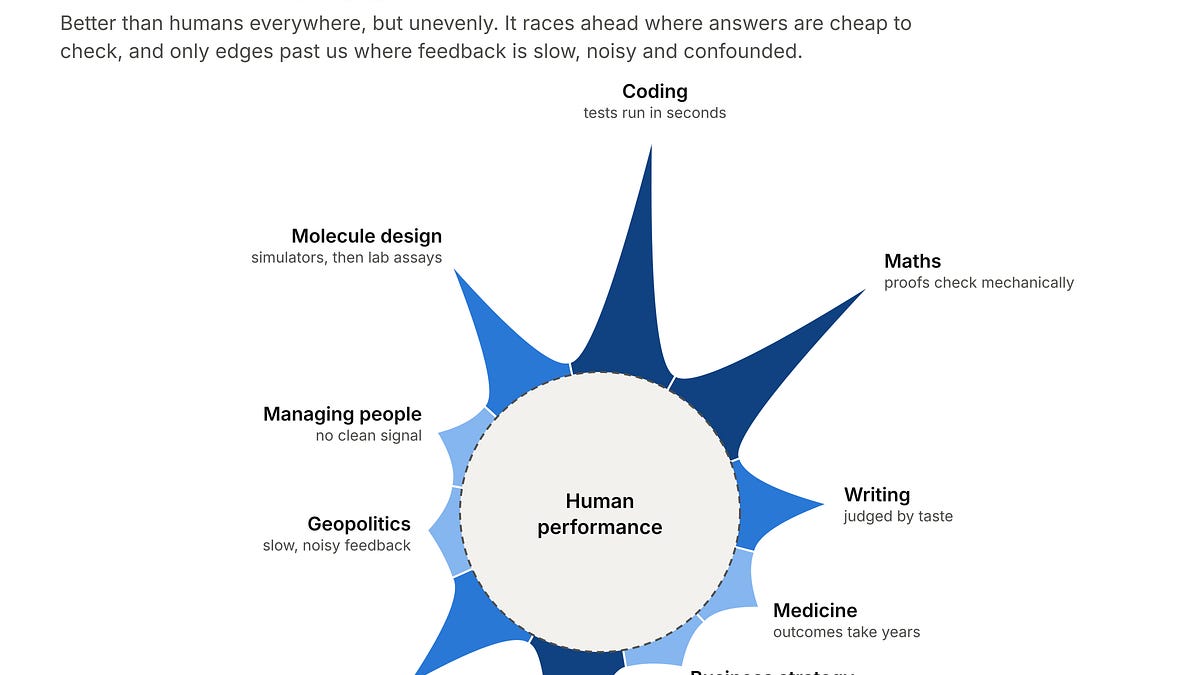
AI is already helping build the next generation of AI. The question isn't whether recursive self-improvement happens. It's who's checking the work while it does.
Link: invertedpassion.substack.comView on X
CTO · EdgeTheory · Mississippi
Chief Technology Officer at EdgeTheory, working in narrative intelligence: understanding the stories that shape what people believe, where they start, how they spread, and where they're heading.

Warren Husband is the Chief Technology Officer at EdgeTheory, a narrative intelligence company that helps government and commercial organizations understand the information environment, including how narratives emerge and spread. Warren leads EdgeTheory's engineering team.
Narrative intelligence is the work of understanding the stories that shape what people believe: Where they start, how they spread, and where they're heading. With more content online than any team can read, the goal is to spot a narrative early enough for leaders in government and business to act before it takes hold.
Warren has worked in software for more than 30 years, since 1995, as an engineer, team leader, IT director, and CTO. Before joining EdgeTheory in 2018, he spent much of that time building systems for healthcare and medical labs. He enjoys working with people as much as with code and keeps the business goal in view above the technical details. Warren lives in Mississippi.
For most of the history of software, using a system meant opening it. You logged in, found the right screen, and clicked through the steps someone designed for you.
The world is producing information far faster than anyone can read it. That gap isn't just an inconvenience.
Everyone wants to know which AI model is best. It's the wrong question.
Recursive self-improvement is already happening, though not in the way science fiction imagined. AI is increasingly helping build the next generation of AI.
AI is already helping build the next generation of AI. The question isn't whether recursive self-improvement happens. It's who's checking the work while it does.
Link: invertedpassion.substack.comView on X

We're building machines that do more of our thinking for us, then acting surprised when people treat them as more than a tool. The real risk may be less about machines becoming gods and more about humans deciding they don't need to think for themselves.
Link: newyorker.comView on X

If AI can discover mathematical truths that humans couldn't find, does understanding the proof become less important? Or does it become more important than ever?
Link: spectrum.ieee.orgView on X

We're approaching a world where knowing how to use an application matters less than knowing what an agent is allowed to do inside it. That's a much bigger shift than a new way to interact with software.
Link: warrenhusband.comView on X

AI governance is going to be as much a geopolitical challenge as a technical one. Countries aren't going to stop developing capabilities because of international agreements. Building enough transparency and mutual trust to make those capabilities less dangerous is a much more realistic starting point.
Link: vox.comView on LinkedIn
We're moving from software people operate to software their agents operate. That's a pretty fundamental change in how applications need to be designed. The interface might become optional, but permissions, security and accountability certainly aren't.
Link: warrenhusband.comView on LinkedIn

National security is moving out of the government relations department and into the boardroom. When your products are foundational to global AI infrastructure, export controls, geopolitical exposure, and commercial strategy become deeply interconnected. That's a different kind of corporate governance challenge.
Link: techcrunch.comView on LinkedIn

Exposed credentials, weak MFA, forgotten vendor access. AI isn't necessarily finding some ingenious new way in. It's making the discovery and exploitation of ordinary security failures dramatically faster and easier to scale.
Link: techcrunch.comView on LinkedIn
1200×1200 JPEG
Short bio
Warren Husband is Chief Technology Officer at EdgeTheory, a narrative intelligence company that helps government and commercial organizations understand the information environment, including how narratives emerge and spread. He leads EdgeTheory's engineering team. Warren has worked in software since 1995, including years building systems for healthcare and medical labs. He lives in Mississippi.
Longer bio
Warren Husband is Chief Technology Officer at EdgeTheory, a narrative intelligence company that helps government and commercial organizations understand the information environment, including how narratives emerge and spread. He leads the engineering team behind EdgeTheory's narrative intelligence platform. Warren has worked in software for more than 30 years as an engineer, team leader, IT director, and CTO. Before joining EdgeTheory in 2018, he spent much of his career building systems for healthcare and medical labs. He holds a B.S. in Computer Science from Belhaven University and lives in Mississippi.
Suggested introduction
Please welcome Warren Husband, Chief Technology Officer at EdgeTheory, who has spent more than 30 years building software and now leads the engineering team behind EdgeTheory's narrative intelligence work.
Skills
Narrative intelligence, technology strategy and leadership, building and scaling engineering teams, AI strategy and adoption, agentic AI and LLM systems, data platforms and cloud architecture
Belhaven University, Jackson, MS. B.S. in Computer Science, minor in Business Administration, 1994 – 1998.